
Online for 8711 days
Last update: 1/4/11, 9:20 AM

time to move! Antville is a symatic community but I'm...
Post is THE company which implemented SOA the first time,...
Hypothesis: Since infrastucture code is not part of the domain...
this time It's the content, stupid http://www.joost.com/home?playNow=33l83ke#id=33l83ke
interface. I'm sceptical http://news.cnet.com/8301-17939_109-10065136-2.html
gives to the Pattern Movement Look what I've found: A...
Alexander—The pattern language that we began creating in the 1970s...
hill in the morning mist. Nasim Taleb explains the...
Roland Kofler's Blog on Software Engineering on


Theories of Probability in the 20th Century, Part II
Pre-WWI Cambridge was a highly influential intellectual center in the first half 20th century with strong mathematical bias, due to people like Bertrand Russell, Ludwig Wittgenstein and John Maynard Keynes. The later, famous for his leftist economic theory compiled in the opus magnum 'The General Theory of Employment, Interest and Money'; did not only ground Roosevelts 'New Deal' or the European social market economy, but contributed with his 'Treatise on Probability' to modern probability what is now known as The logical Theory.
Keynes believes that that logical relations can be applied to probability events, so that fundamental problems of induction in probability (e.g. a black swan) can be solved. Probability is a degree of partially entailment of a hypothesis. From the observation of all swans, they were all white, follows partially and to a certain degree that all swans are white.
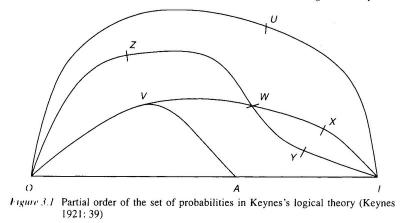
Interestingly Keynes does not believe that the degree of entailment is always computable, on the contrary probabilities might not comparable at all:
 .
.
0 represents impossibility, 1 certainty, and A a numerically measurable probability intermediate between 0 and 1; U, V, W, X, Y, Z are non-numerical probabilities, of which, however, V is less than the numerical probability A, and is also less than W, X, and Y. X and Y are both greater than W, and greater than V, but are not comparable with one another, or with A. V and Z are both less than W, X, and Y, but are not comparable with one another; U is not quantitatively comparable with any of the probabilities V, W, X, Y, Z.Keynes 'A Treatise on Probability' 1921:39
... link
Erlang - the movie
Geeky!
... link